Showing posts with label Disney. Show all posts

Tuesday, March 2, 2010

The Most Expensive Breakfast

We drove 12 straight hours from Virginia to Orlando, arrived late at night, and decided to get a big breakfast in the morning.

Since it was the lady's first time to Disney World, she had a priority to-do list:
  • Character breakfast with Mickey-shaped waffle
  • Mickey-shaped ice cream
  • A bunch of other things that I now forget 
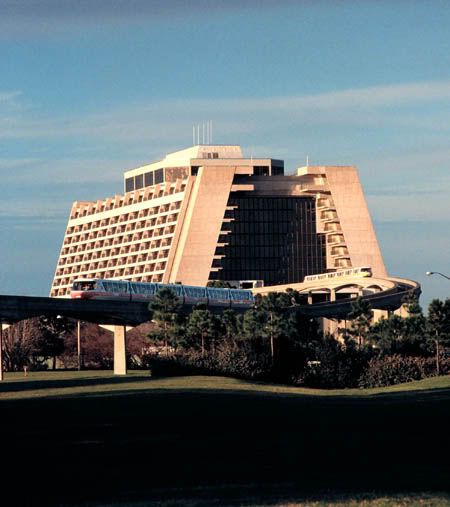
The character breakfast is where you eat, usually a buffet, and Disney characters walk around and allow you to take pictures with them.  It sounds cheesy and unnecessary, and it is, but once you're there it doesn't seem horrible.  We walked into the Contemporary Resort.


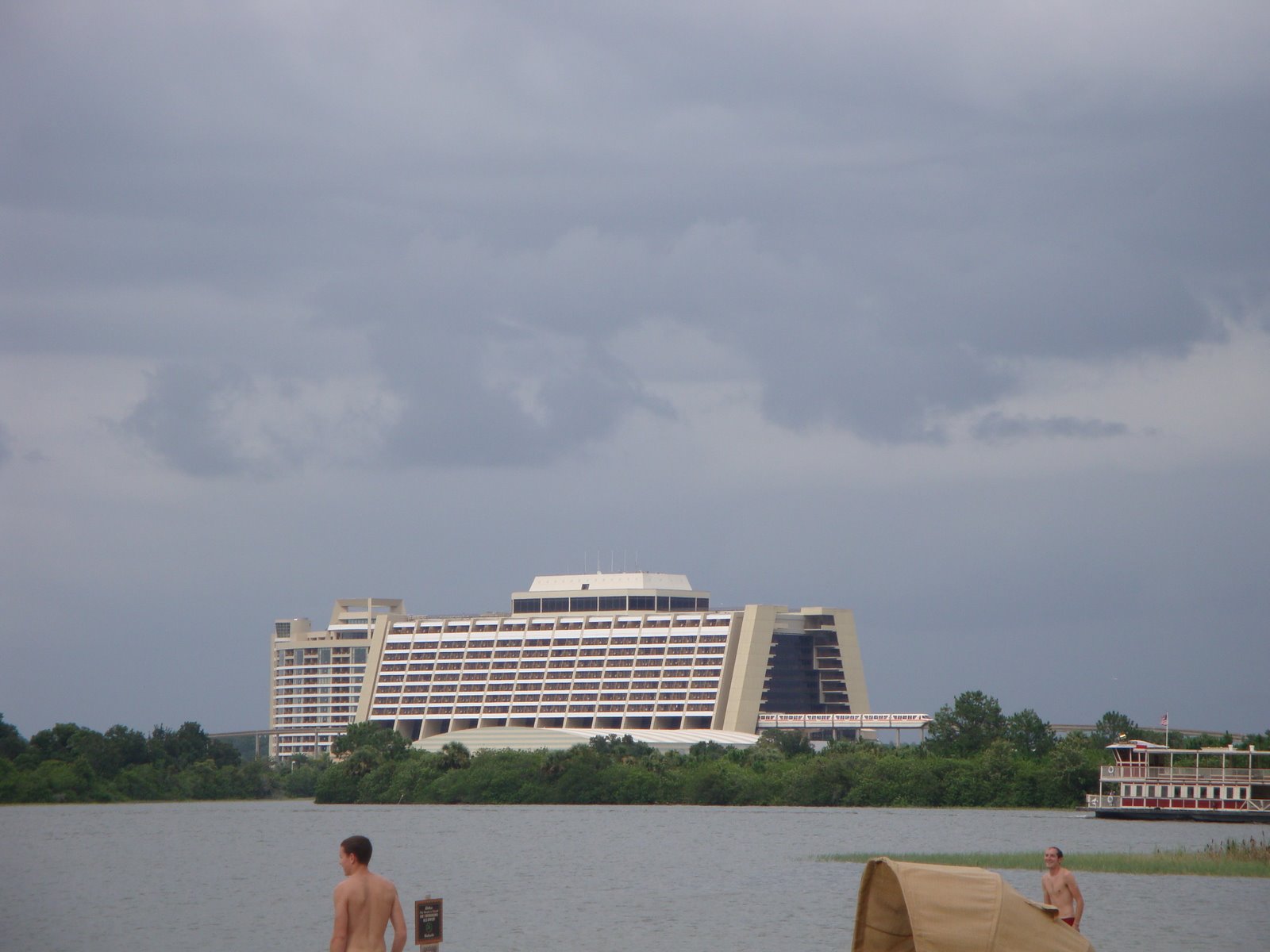
The Contemporary was built in an era where concrete was considered modern. When you compare it to other Disney World hotels, it seems too cold and serious. I think only business/conference people stay there, my Disney professor said that only boring, cold people did.  The feature that gives the hotel any character is that the monorail runs through the lobby:

The mural in the lobby is by Mary Blair, who the lady thinks was either a genius, or drug-induced nut. (Blair had an astigmatism, and was also an alcoholic).  It's a Small World is an acid-trip through Blair's mind.

Inside this hotel are a few restaurants, including the character buffet Chef Mickey's, recommended to us by a friend who claimed the food was better than other buffets with less screaming kids.


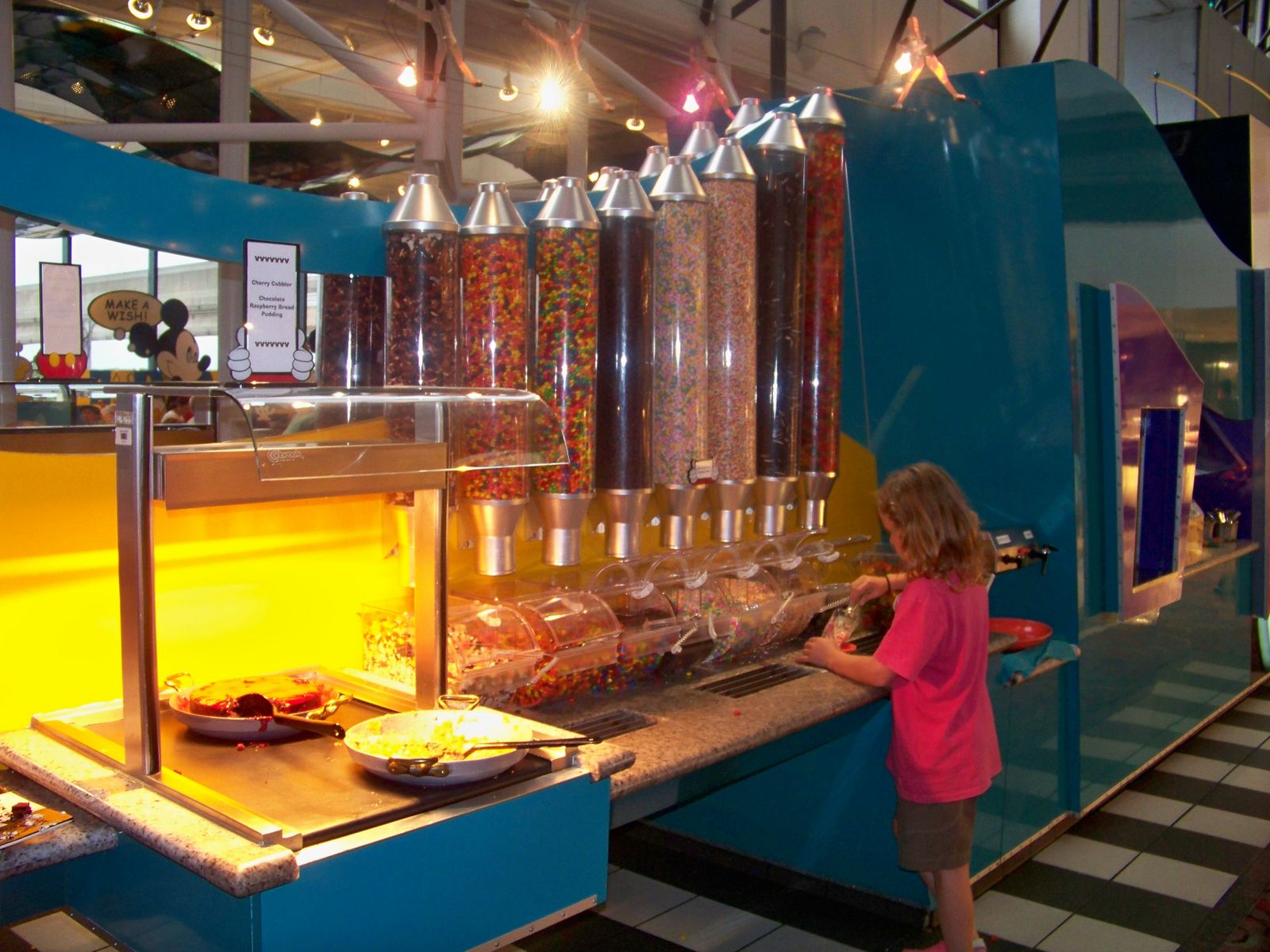
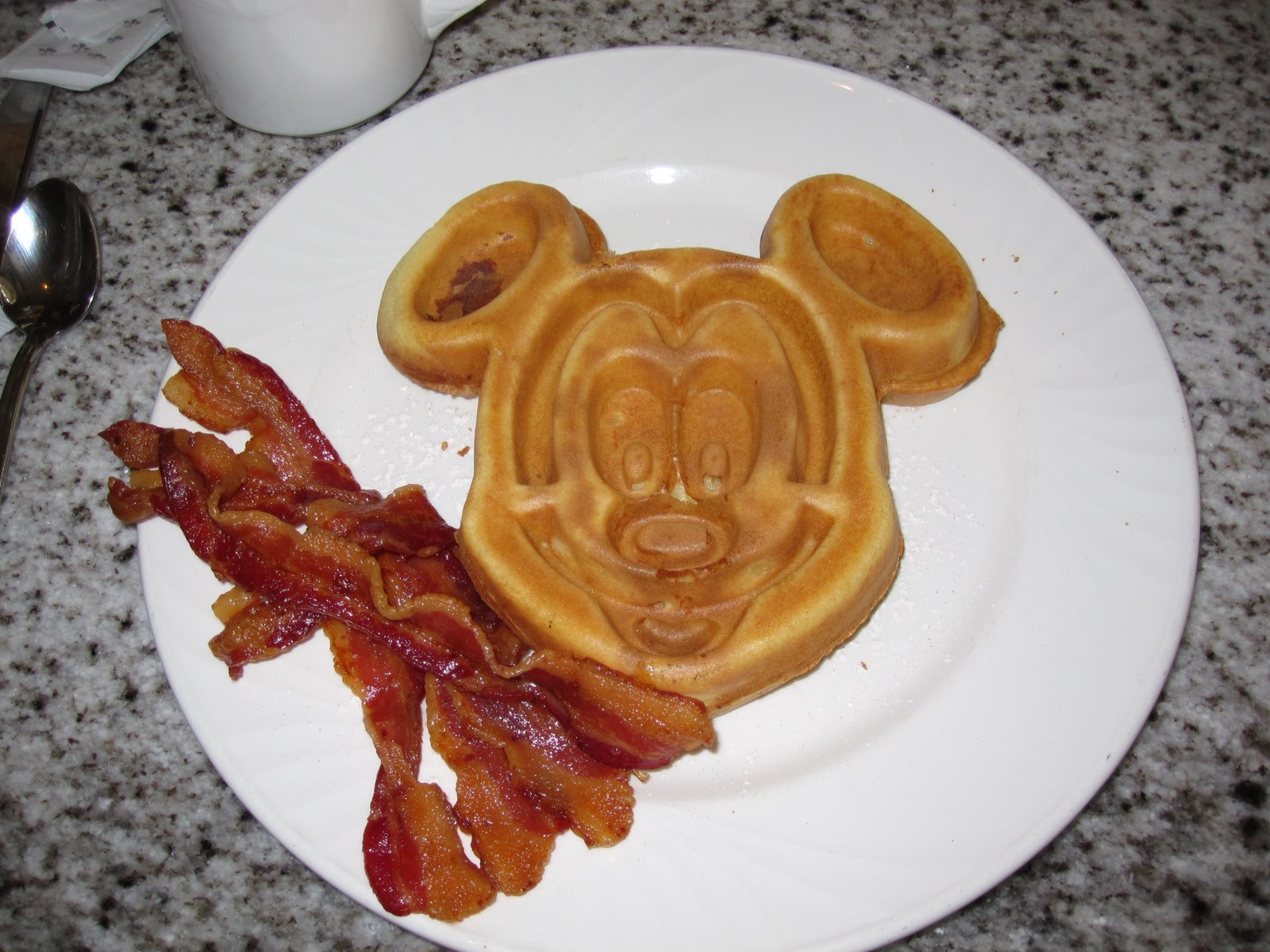
We were seated right away, despite not having reservations.  Some old Dutch guy was our waiter.  The buffet was stacked: french toast, waffles, pancakes, blintzes, donuts, fruit, capers and lox, candy, "breakfast pizza", meats, hashbrowns, a potato/pepper/cheese mix, eggs of many types... it's just excellent.  And of course, they had the Mickey Waffle:

 
Blintzes and something on the left, cereal and CANDY (!?) in the clear canisters.
 

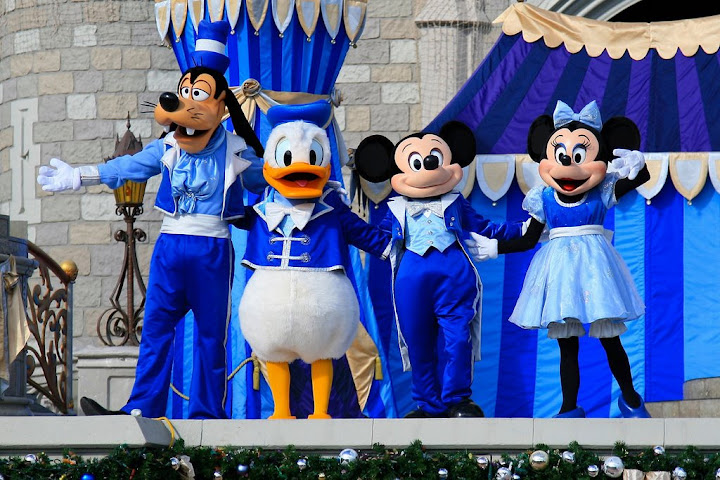
We sat next to a window that overlooked the Magic Kingdom, with the iconic castle and Space Mountain in view.  She cried because it was her first time at Disney World, it was the first morning after a long drive, and there she was overlooking the place as Mickey and other "classic" characters went to each table mugging for photos and autographs.

Overall, the food was really good.  But then there was the bill.  It was around $70 (for the both of us).  This was the most expensive breakfast I will ever have, far more than breakfast at the Ritz in Dearborn, MI.

But the $70 price tag brings in the idea of "experience as a commodity", a distinctly 20th century realization that Disney has perfected.  This breakfast wasn't $70 worth of food.  The price involved having your picture taken with Disney character-suits and being able to look out over the Magic Kingdom.  Having a picture taken is far more important to children, as is the episode where a song started playing and the characters danced.  For $35, she was invited into the Disney culture of paying for memories.
As Adorno said,
The cultural commodities of the industry are governed by the principle of their realization as value, and not by their own specific content and harmonious formation.  The entire practice of the culture industry transfers the profit motive naked onto cultural forms.

The World

In November 2009, we decided to go to Disney World. The lady had never been at all, and I've obviously been influenced by the place... even through college. Most adults consider Disney World to be a place for kids, the cynical-type may think of it to be the "ultimate in fakery".  Most likely, these people haven't visited as adults (without children).  I can't blame them, but most people can't envision a trip there to be worthy of their time, or precious dollar.  Walt's vision, though, was to strip adults of their society-induced roles of having to be serious, and instead create an environment where they would have as much fun as youth.  David Johnson wrote in an essay:

All people manage their behavior so that they separate their frontstage from their backstage behavior. Invasions of privacy or slips showing backstage behavior are to be avoided at all  costs.
And that's pretty much the crux of the matter. If you've been to Disney World/Land as an adult, without children, then you knowAlexander Moore described how Disney World/Land is an American rite of passage, or a pilgrimage center.
A pilgrimage center is a bounded place apart from ordinary settlement, drawing pilgrims from great distances as well as nearby.  It must have some place of congregation, some symbols on display readily understood by the congregated pilgrims.

Although expensive, there are a lot of things to do and appreciate as adults.  The operations-side of the place is staggering to consider.  There have been books devoted to the subject (more than two).

I'll spare more on the theory and get to the food.  Food at Disney World is overpriced.  It is not, however, typical amusement park grease-fare.  For the most part, thought is put into menus and the final product.  Portions are generally excessive, or at the minimum, entirely adequate.  Most Disney food can be split in two and still fill each person up until the next meal.

For example, there's a place in the Magic Kingdom where you can order a burger, and then load up on it with a ridiculous amount of fixin's (for free), from grilled onions, grilled shrooms, nacho cheese sauce, practically everything you could want on a burger. 

Aforementioned fixin' bar At Pecos Bill Cafe

One breakfast that we ate was Tonga Toast at the Polynesian Resort, a place that she claimed was "more Hawaiian than Hawaii is."  If she were a postmodern academic philosopher, she would have said that the Polynesian Resort is an example of simulacra, where the simulation of Hawaii has played to what we believe Hawaii looks like.  Eco's claim of hyperreality also stands:
In this sense Disneyland is more hyperrealistic than the wax museum, precisely because the latter still tries to make us believe that what we are seeing reproduces reality absolutely, whereas Disneyland makes it clear that within its magic enclosure it is fantasy that is absolutely reproduced. The Palace of Living Arts presents its Venus de Milo as almost real, whereas Disneyland can permit itself to present its reconstructions as masterpieces of falsification, for what it sells is, indeed, goods, but genuine merchandise, not reproductions. What is falsified is our will to buy, which we take as real, and in this sense Disneyland is really the quintessence of consumer ideology.
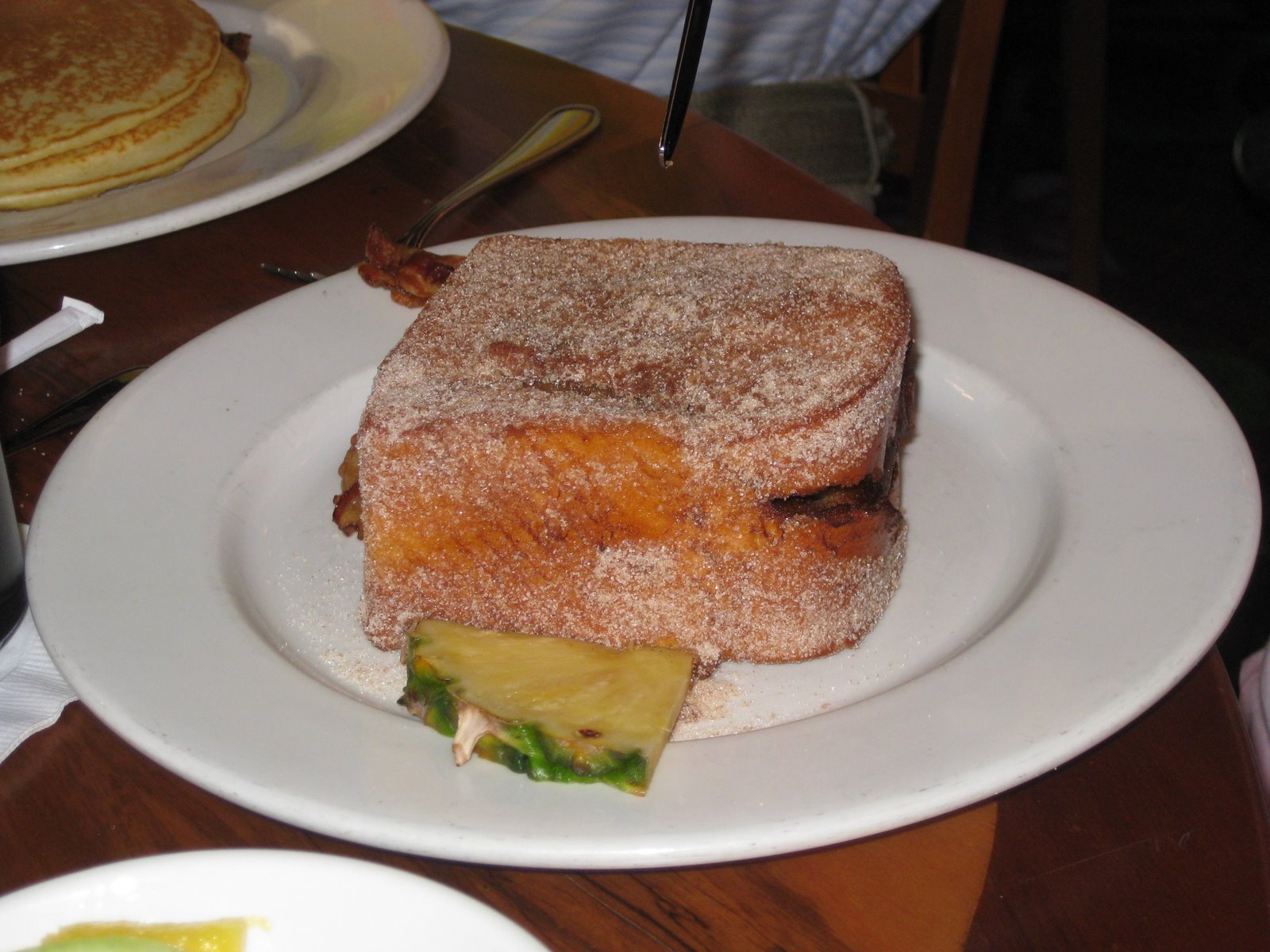
Changing subjects, Tonga Toast is sourdough french toast with cinnamon; in-between the two slabs of bread are grilled bananas.  I hate sourdough, but the taste was masked by cinnamon and banana.  An absolutely wonderful way to start the day.  The portion?  Humongous.